
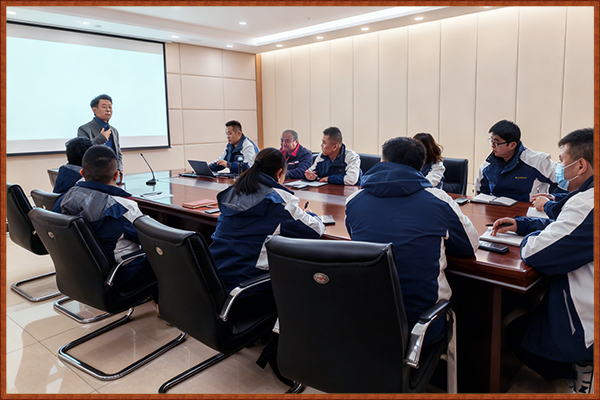
Recently, middle-level leaders from Shandong Shanding Group’s Yucheng, Shanding plant gathered for an internal training session, where a senior trainer from Tiancheng Group was invited to deliver a presentation on the theme of “Management Forging Workshop.” This informative event, focusing on the essence of management and transformation practices, illuminated the direction for the middle-level managers. The following three key highlights are worth reflecting upon.
I. Redefining Management Salon: More Than Just “Managing Things,” It’s About “Managing People” Peter Drucker once said, “Management is doing things right; leadership is doing the right things.” The training clearly pointed out that the core essence of management is the dynamic practice of “managing things + managing people.” “Managing” refers to rules, standards, processes, and systems to ensure execution efficiency; “managing” refers to people’s hearts, human nature, emotions, and rationality to build team cohesion. Just as the *Tao Te Ching* says, “Governing a large country is like cooking a small fish,” management also requires a grasp of timing and proportion: it cannot involve frequent intervention or constantly changing orders, nor can it be negligent or laissez-faire. Only by respecting the natural order and acting in accordance with it can a balance be found between institutional constraints and humanistic care, achieving the healthy development of the team and organization.
II. Three Major Transformations Reshaping Managers’ Mindset, Thoughts, and Responsibilities
The transition from executor to manager hinges on completing three major transformations. In terms of mindset, it’s crucial to shift from being “responsible for oneself” to being “responsible for the team,” treating subordinates’ affairs as one’s own and viewing the team’s growth as one’s own achievement, moving from “doing it oneself” to “teaching others to do it.” Mentally, it’s essential to upgrade from “athlete” to “coach,” transcending the limitations of personal performance and considering how to replicate successful experiences, refine team strengths, and formulate clear team goals and execution plans. Regarding responsibilities, rights, and obligations, it’s vital to understand that a manager’s core responsibility is not only to achieve results personally but also to lead the team to achieve results, effectively utilizing legal authority, reward and punishment authority, and personnel authority to achieve a win-win situation for both personal and team benefits.
III. Understanding the “Hidden Foundations” of Management Capabilities The core competitiveness of excellent managers lies hidden in the deep logic of the “iceberg model”: Upper Iceberg (30%): Easily assessable and cultivateable knowledge and skills, such as industry expertise and the ability to use management tools—the “hardware foundation” of management. Lower Iceberg (70%): Difficult-to-cultivate yet decisive qualities and potential, including mindset, communication and coordination skills, values, and professional attitude—the “hidden foundations” of management. When assessing managers, one should not only look at “whether they can do things,” but also pay attention to “whether they have potential” and “whether their values align with yours.” When building a profile of qualified subordinates, it is also necessary to consider both attitude (work motivation, career aspirations, humility and respect) and ability (negotiation skills, needs assessment, sales mindset), distinguishing between essential, cultivateable, and non-essential abilities to achieve accurate talent identification and efficient talent development.
IV. Completing the Key Leap from Executor to Manager
A skilled performer ≠ a qualified manager. Middle-level leaders who want to overcome the challenges of transformation need to achieve three core shifts:
Mindset Shift: From “Responsibility for Myself” to “Responsibility for the Team.” Abandon the personal mindset of “I won’t do anything that doesn’t concern me,” and establish a team consciousness of “Their problems are my problems,” proactively supporting the growth of subordinates and the team’s results.
Thought Shift: From “Athlete” to “Coach.” Step out of the comfort zone of personal execution, focusing on team goal planning, replicating successful experiences, analyzing members’ strengths and weaknesses, and building support systems, rather than excessively intervening in specific tasks.
Relative, Rights, and Interest Shift: From “Focusing on Personal Gains” to “Balancing Team and Personal Gains.” Clearly understand that you bear dual responsibility for results—both personal and team—and effectively utilize legal authority, reward and punishment authority, and personnel authority to ensure that team gains resonate with personal growth.
VI. Collaborative Breakthrough: Breaking Down Departmental Silos to Achieve Cross-Departmental Win-Win
In complex organizational structures, cross-departmental collaboration is a crucial capability for middle-level managers. To address the issue of departmental silos, the training proposed five systems for breaking down barriers: a goal and responsibility system to align goals and interlock interests; a RACI responsibility matrix to clarify departmental roles and avoid shirking responsibility; a communication and information synchronization system to establish standardized communication channels and synchronization mechanisms; a process and work order flow system to achieve visualized work tracking; and a problem and conflict resolution system to delve into root causes using the 5 Whys analysis method, focusing on solutions rather than blame.
The training emphasized that the core of cross-departmental collaboration is building a mechanism of trust and win-win cooperation. This is achieved through job rotation and cross-departmental team building to enhance understanding, and by establishing awards such as “Collaboration Stars” to strengthen positive incentives, transforming departments from “working in isolation” to “collaborative operations.”
Middle managers are the “backbone” of the organization, acting as both guiding lights and bridges connecting people. This training enabled the middle-level leaders of Shandong Group to deeply understand that the ultimate value of management lies in fusing the mechanical and biological aspects of an organization into an organic whole, finding a balance between the “tools” of systems and the “absence” of humanity, and becoming outstanding leaders who are both strategically astute and compassionate.
In the future, we hope that every middle-level manager can carry the wisdom gained from this training, continuously refine their skills and advance their abilities in management practice, and lead their teams steadily forward on the path of development!